
Prepared by Richard Plehn, Lisa Ann Pollakowski, Vanessa Ollarves and Steve Gardner.
Please click on the slideshow below for the full report. Alternatively, you can also follow the link on the button to read it on PDF.
THE U.S. AND NEW YORK CITY ECONOMIC OVERVIEW
National Trends
The U.S. economy continues to show positive momentum. Over the past year, the monthly civilian labor force expanded from 168.3 million to 171.6 million, reflecting a notable increase in workforce participation. Despite this growth, the unemployment rate edged higher to 4.6%. Nevertheless, the number of people employed grew substantially, with approximately 2.31 million more individuals working compared to the previous year. Although overall job growth is decelerating, the labor market remains resilient.
Financial indicators also point to incremental shifts. The 10-year treasury rate decreased modestly, moving from 4.57% last year to 4.18% this quarter, suggesting a slightly more favorable borrowing environment. Meanwhile, the travel and tourism industry continues its recovery, as nationwide hotel occupancy rates improved to 63.4%.
New York City Trends
In December, New York City added 16,300 private sector jobs, marking a new record for total jobs in the city. However, job growth moderated in 2025, with a total of 33,400 private sector jobs added over the year. This represents a significant slowdown compared to the 114,500 jobs added in 2024.
This deceleration in job growth was not unique to New York City. Across the United States and most major metropolitan areas, employment expansion slowed in 2025. The primary factors contributing to this trend were higher-than-expected interest rates and ongoing uncertainty surrounding federal policies in the previous year.
Despite the slowdown, the broader New York City metro area remained the leader among major metros, adding 48,400 jobs over the past year. This figure exceeds the combined job gains in Dallas, Miami, Atlanta, and Houston, underscoring the region’s continued economic strength.
As of December 2025, the seasonally adjusted unemployment rate in New York City was 5.6%, remaining unchanged from December 2024 but slightly higher than the previous month.
The city’s rate is higher than the overall New York State unemployment rate, which was 4.6% in December 2025.
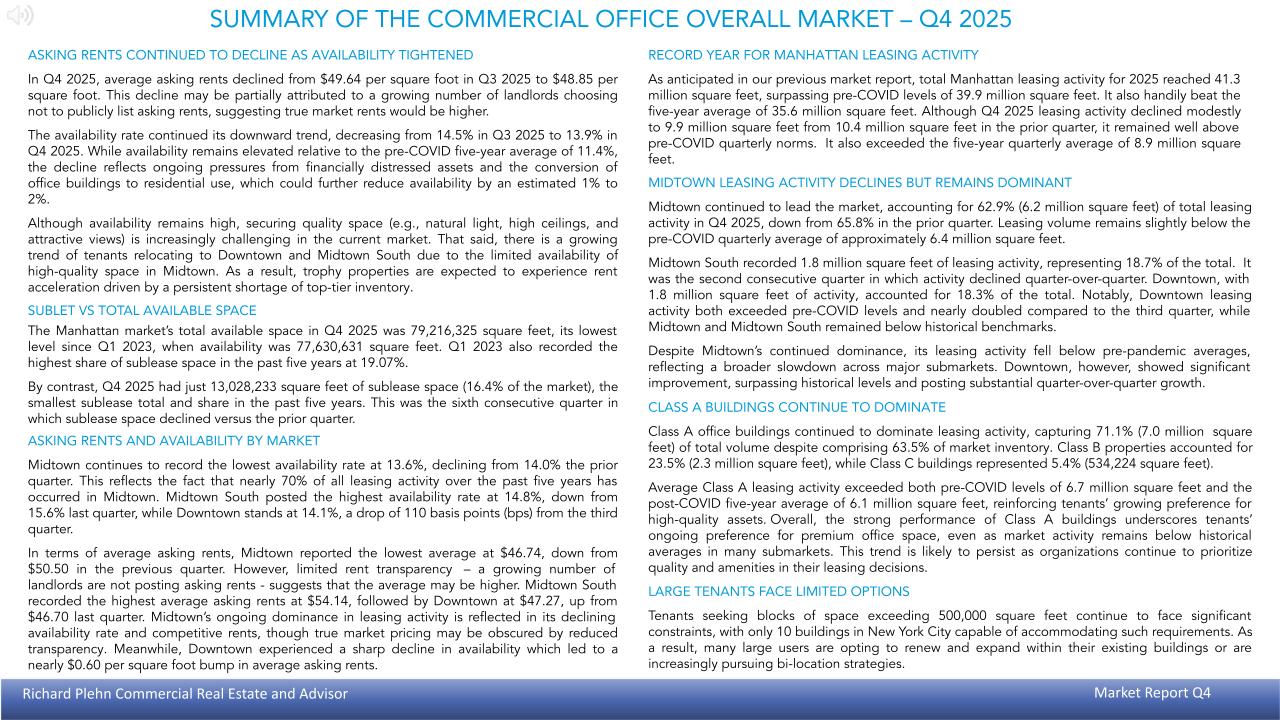
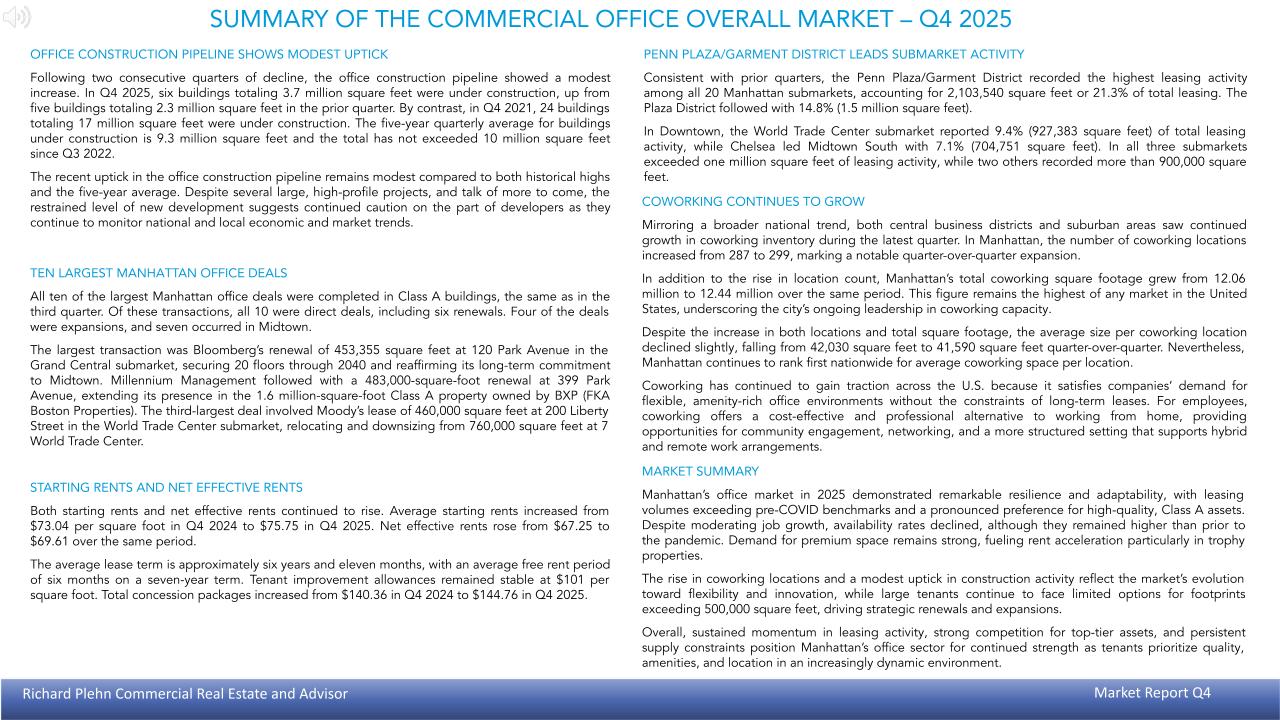
EXECUTIVE SUMMARY – MANHATTAN OFFICE MARKET | Q4 2025
- The U.S. economy showed continued, albeit moderating, improvement in Q4 2025.
- Employment levels increased year over year despite slower job growth, interest rates eased modestly, and hotel occupancy rose nationwide, reflecting sustained recovery in travel and business activity.
- New York City continued to outperform the national economy, supported by strong tourism, a diversified industry base, and continued expansion among AI and technology firms.
- Manhattan recorded a historic year for office leasing, with total 2025 activity reaching 41.3 million square feet—surpassing pre-COVID levels.
- Although quarterly leasing volume declined slightly from Q3, activity remained well above historical norms.
- Midtown continued to dominate leasing volume, though Downtown was the only market to exceed pre-pandemic performance, reflecting shifting tenant preferences amid limited high-quality inventory in Midtown.
- The Penn Plaza/Garment District recorded the highest leasing activity among all 20 Manhattan submarkets, accounting for 2,103,540 square feet or 21.3% of total leasing.
- Availability continued to decline across Manhattan, falling to 13.9%, though it remains above the pre-COVID average.
- Despite elevated availability, demand for high-quality space remains strong, and tenants are increasingly challenged to secure premium offices.
- Asking rents declined on average by $0.79 per square foot, to $48.85; however, limited transparency (i.e., landlords not posting asking rents) suggests effective rents are materially higher than reported averages.
- Class A buildings continued to capture the majority of leasing activity, accounting for more than 70% of total volume. This underscored the ongoing flight to quality.
- Large tenants face significant constraints, with very limited options for blocks exceeding 500,000 square feet, driving renewals, expansions, and bi-location strategies.
- While new office construction remains historically low, the pipeline increased modestly this quarter.
- Both starting rents and net effective rents continued to rise, reflecting strong competition for top-tier assets.
- Looking ahead, leasing activity is expected to remain above pre-COVID levels, driven by AI and technology tenants, with trophy assets positioned for rent growth due to persistent supply constraints.